
Emporia is building the nation's largest virtual power plant, one home battery at a time.
See if your home qualifies Learn about our visionFor 150 years, the U.S. electrical grid ran one way: large centralized power plants pushed energy out to homes through long transmission lines. Supply adjusted to meet whatever demand did. Now demand is changing fast, and the supply-side model cannot keep up.
Homes that once drew 100 amps are being wired for 200. As electric vehicles, heat pumps, and electric appliances replace gas, the average home is heading toward 300-amp service. Building enough new power plants, transmission, and distribution capacity to meet that demand the old way carries a price tag approaching $1 trillion. There is a better path: manage demand intelligently, at the home level, at scale.
For 150 years, grid operators balanced supply and demand by building more power plants. Distributed home batteries let utilities manage from the demand side, reducing peak load without new infrastructure.
Peaker plants are the most expensive and carbon-intensive assets on the grid. They run only a few hundred hours per year. The Rocky Mountain Institute estimates distributed storage and VPPs could reduce grid carbon by 70%.
Two million connected batteries give utilities the ability to make energy appear or disappear in any neighborhood at a click. That is the Emporia goal, and it is the scale at which distributed storage becomes a grid asset, not just a home product.
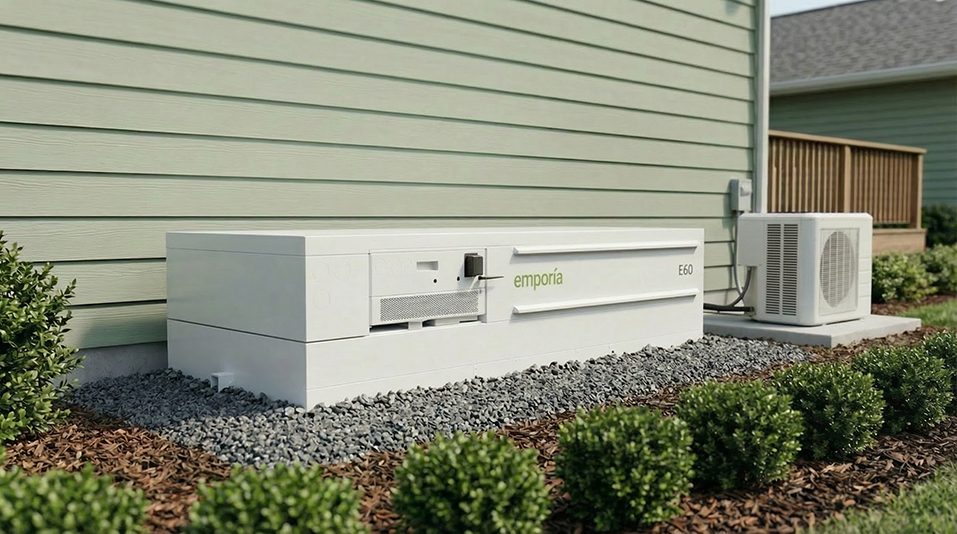
The Emporia platform monitors 400,000+ homes at second-level fidelity: every circuit, every device, every dollar of energy spend. When a battery connects to that platform, it does not just store energy.
It optimizes around solar generation, EV charging schedules, utility rate structures, and real-time home demand. The battery is always in the right state of charge, ready for the next grid dispatch event and for the peak-rate window that arrives every evening.
That whole-home context is what separates an Emporia battery from a standalone storage device. The data advantage compounds with every home added to the network.
The third-party ownership model removes the primary barrier to residential battery adoption: upfront hardware cost. Utility capacity programs provide the revenue stream that makes it work.
Emporia installs, owns, and maintains the battery system. No hardware purchase, no maintenance cost or monthly fees.
State utility demand response programs pay for committed battery capacity. These programs make it possible to deploy hardware at no cost to qualifying homeowners while generating long-term revenue to sustain the model.
When Emporia is not dispatching to the grid, homeowners have access to their battery for backup power during outages. The battery connects to the full Emporia platform: monitoring, scheduling, and solar optimization included.
Eversource
Sign-ups opening soonEfficiency Maine
Sign-ups opening soonWe have a 5 to 10-year window to build the distributed infrastructure that reshapes how America generates and manages electricity. We are moving fast.