Key Takeaways
- A NEMA 14-50 outlet is safe for EV charging only when it is rated for continuous high-amperage use, installed correctly, and inspected for wear.
- The National Electrical Code limits a continuous load to 80% of circuit capacity, so a 50-amp NEMA 14-50 circuit supports no more than 40 amps of EV charging.
- Look for the green EV-rated symbol, industrial-grade construction, UL listing, and a 75°C continuous-duty temperature rating.
- A proper 50-amp EV charging circuit is dedicated to the charger and typically uses 6 AWG copper wire with a 50-amp breaker.
- Hardwiring eliminates the outlet as a failure point and can support up to 48 amps on a 60-amp circuit.
The NEMA 14-50 outlet has become the standard for home EV charging, and for good reason. It delivers 240 volts of power, charges most EVs overnight, and uses a familiar plug format found in homes across the country. But here’s something worth knowing: this outlet wasn’t originally designed with electric vehicles in mind.
That doesn’t mean NEMA 14-50 outlets are unsafe for EV charging. They work well when installed correctly with quality components. The key is understanding what “correctly” means, because EV charging places different demands on an outlet than the appliances it was designed for. A little knowledge here goes a long way toward protecting your home and giving you peace of mind every time you plug in.
This guide covers what makes a NEMA 14-50 installation safe, how to identify an EV-rated outlet, and what to do if you already have an outlet installed. The key takeaway: EV charging requires an outlet specifically designed for continuous, high-amperage loads, not just any 14-50 receptacle that happens to fit the plug.
Why EV Charging Is Different From Other 240V Appliances
The NEMA 14-50 outlet was originally designed for electric ranges, dryers, and RV hookups. These appliances share something in common: they use power in short bursts. Your dryer runs for an hour a few times a week. Your oven cycles on and off during cooking. An RV might draw heavy power for air conditioning, but rarely for extended periods.
EV charging works differently. When you plug in your car at night, the charger draws near its maximum rated current for six, eight, sometimes ten hours straight. Electricians call this a “continuous load,” defined as any load that runs at maximum for three hours or more.
This distinction matters because of how heat builds up in electrical connections. Every connection point in an electrical system generates a small amount of heat from resistance. With intermittent use, that heat dissipates between cycles. With continuous use, heat accumulates faster than it can escape.
The National Electrical Code accounts for this with what’s called the 80% rule. For continuous loads, you can only safely use 80% of a circuit’s rated capacity. On a 50-amp NEMA 14-50 circuit, that means 40 amps maximum for EV charging. This isn’t arbitrary. It’s the threshold where heat generation stays manageable over multi-hour charging sessions.
Most Level 2 EV chargers are designed with this rule in mind. A charger rated for a NEMA 14-50 outlet typically maxes out at 40 amps, staying within safe limits. The issue isn’t the charger. It’s whether the outlet itself can handle that sustained load night after night.
What to Look for in an EV-Rated NEMA 14-50 Outlet
Why EV-Rated Matters
Walk into a hardware store and you’ll find NEMA 14-50 outlets ranging from $12 to over $90. They look similar. They have the same plug configuration. But there’s a critical difference: only some are designed for the continuous, high-amperage demands of EV charging.
An EV-rated or industrial-grade outlet is engineered to handle 40 amps of continuous current for hours at a time, night after night, year after year. A standard residential outlet is designed for the intermittent use patterns of dryers and ranges. Using the wrong one for EV charging is like using a garden hose for a fire hydrant’s job. It might work initially, but it’s not built for that duty cycle.
The contacts that grip the plug prongs are where quality matters most. EV-rated outlets use solid brass or heavy copper alloy contacts that maintain consistent pressure over thousands of insertion cycles. Budget outlets often use plated steel or thin alloys that oxidize over time, increasing electrical resistance. Higher resistance means more heat, and more heat accelerates degradation. It’s a cycle that can end badly.
Housing materials matter too. Industrial-grade outlets use thermoset plastics that won’t soften or deform even at elevated temperatures. Cheaper outlets use thermoplastics that can warp under the sustained heat of EV charging.
Temperature ratings reveal the difference clearly. EV-rated outlets are typically rated to 75°C (167°F) for continuous operation. Standard residential outlets are often rated to just 60°C. That 15-degree gap becomes significant when you’re drawing 40 amps for eight hours every night.
How to Identify an EV-Rated Outlet
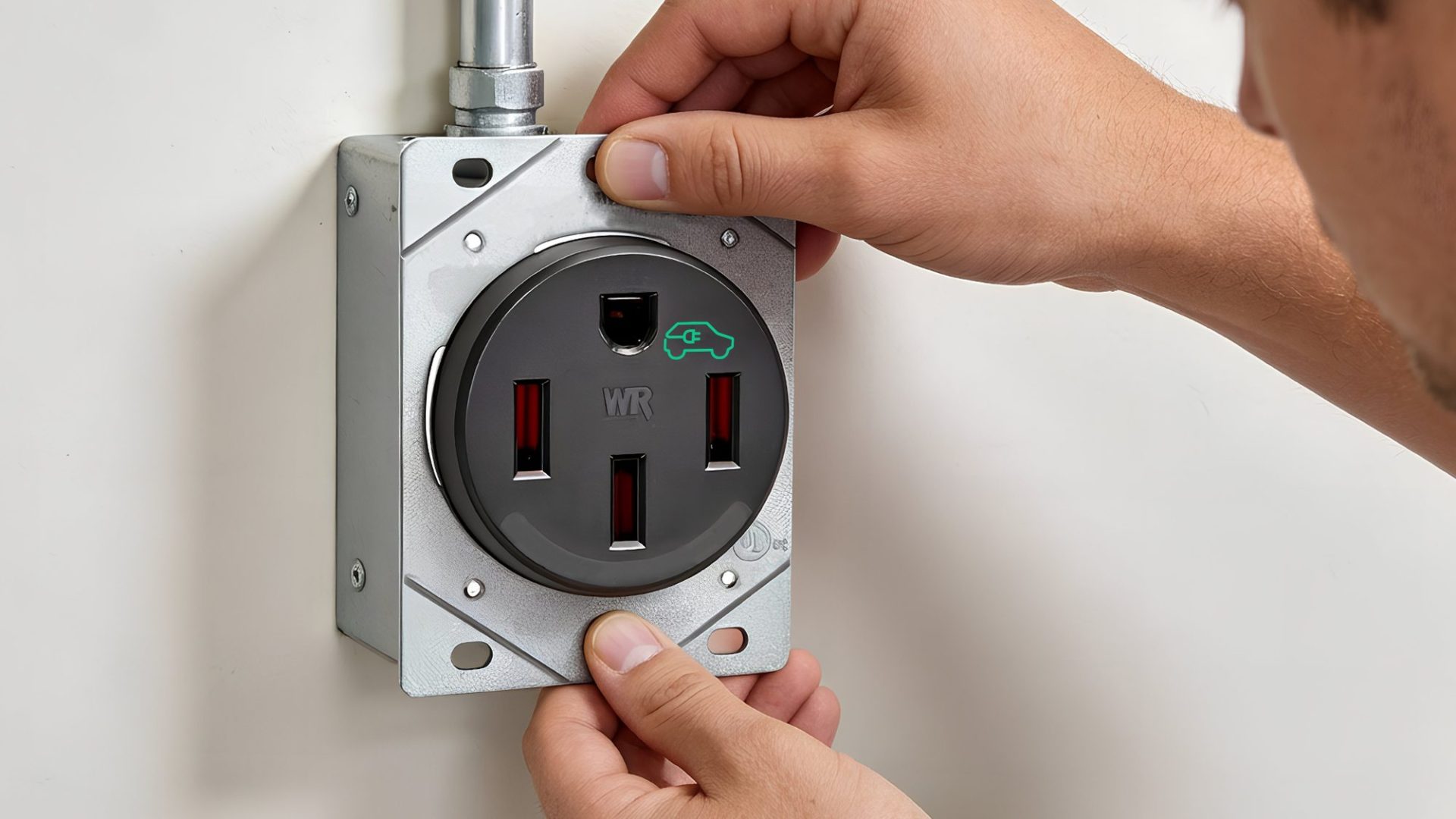
The simplest way to know an outlet is designed for EV charging is to look for the EV-rated symbol: a small green car logo stamped on the outlet face. This marking indicates the outlet has been specifically engineered and tested for the continuous, high-amperage demands of electric vehicle charging.

Close-up view of a NEMA 14-50 outlet with the EV-rated symbol
Beyond the logo, check the outlet’s specifications. An EV-rated outlet will typically be labeled as “industrial grade” or “commercial/industrial grade” and rated for continuous duty at 50 amps. The temperature rating matters too: look for 75°C (167°F) rather than the 60°C rating found on standard residential outlets.
If you’re shopping for an outlet and don’t see the green car symbol, look for explicit language about continuous load ratings or EV charging suitability. When in doubt, ask your electrician to source an outlet specifically designed for EV charging applications.
What should you avoid? Generic unbranded outlets from marketplace sellers, anything priced dramatically below name-brand equivalents, and residential-grade outlets not designed for continuous duty. The $15 you save on a cheap outlet isn’t worth the risk.
UL Certification: What It Means and How to Verify
UL (Underwriters Laboratories) certification means a product has been independently tested for safety. For electrical outlets, UL testing covers mechanical durability, electrical performance, and thermal behavior under load. It’s not just a sticker. It represents real engineering validation.
To verify an outlet is genuinely UL listed, look for the UL mark (the letters “UL” in a circle), the word “LISTED” in capital letters, and a control number you can check against UL’s online database. Counterfeit products exist, particularly from overseas sellers, and they may carry fake UL marks.
Why does this matter beyond safety? Insurance. If a fire starts from electrical equipment, your homeowner’s insurance will investigate. Non-UL-listed components can complicate claims or even void coverage. It’s one more reason to stick with reputable brands from established retailers.
What Can Go Wrong With the Wrong Outlet
Using a cheap, worn, or non-EV-rated outlet for daily charging creates real risks. Here’s what can happen over time.
Overheating. Standard outlets weren’t designed for hours of continuous high-amperage draw. The contacts generate heat, and without proper materials and construction, that heat accumulates faster than it dissipates. Outlet temperatures can climb well above safe operating limits during normal charging sessions.
Softened or melted plastic. Residential-grade outlets often use thermoplastic housings that soften and deform under sustained heat. Once the housing warps, contact alignment suffers, which increases resistance and generates even more heat. It’s a dangerous feedback loop.
Damaged contacts. Thin or low-quality contacts oxidize and wear down over thousands of charging cycles. As contact quality degrades, electrical resistance increases at those connection points. Higher resistance means more heat at exactly the spots least able to handle it.
Fire hazard. The end result of these compounding issues can be arcing, melting, and potentially fire. Documented cases of NEMA 14-50 outlet failures from EV charging show scorched outlets, melted plugs, and smoke damage. In some cases, only a smoke detector or the charger’s built-in thermal protection prevented a house fire.
The concerning part: these failures often don’t happen immediately. An undersized outlet might work fine for months before cumulative thermal damage reaches a critical point. By then, the warning signs (discoloration, loose fit, unusual warmth) may have been easy to miss.
Why Professional Installation Matters
Installing a NEMA 14-50 outlet involves working inside your electrical panel with wires carrying enough current to cause serious injury. Even if you’re comfortable with basic electrical work, the stakes here are higher than swapping a light switch.
A proper EV charging circuit must be dedicated, meaning it serves only the EV charger and nothing else. Sharing a circuit with other appliances creates safety issues and violates electrical code. The circuit also needs the correct wire gauge (typically 6 AWG copper for a 50-amp circuit) and an appropriately sized breaker.
Common DIY mistakes include using undersized wire (8 AWG when 6 AWG is required for a 50-amp circuit), failing to torque terminal connections properly, sharing a circuit with other loads, and selecting the wrong breaker size. Any of these can create conditions for a future failure, and the failure might not happen immediately. It might happen a year later, after thousands of thermal cycles have loosened a connection that wasn’t quite tight enough.
Professional installation typically includes a load calculation to confirm your panel has capacity, a dedicated circuit run with appropriate wire gauge, terminal connections torqued to manufacturer specifications with a calibrated tool, proper conduit and wire management, and a final inspection that documents code compliance.
That inspection matters more than you might think. Unpermitted electrical work can void your homeowner’s insurance and create complications when you sell your home. The permit and inspection typically cost $50 to $200, and they establish that your installation meets code.
Questions to Ask Your Electrician
If you’re hiring an electrician, a few questions can help ensure quality work:
-
What brand and model outlet will you install? (You want to hear a name like Hubbell, Bryant, or Leviton’s continuous-duty models, not “whatever’s in the truck.”)
-
Will you torque the connections to spec? (Proper torque requires a calibrated torque wrench, not just “tight.”)
-
Is a permit required, and will you pull one? (In most jurisdictions, yes, and a good electrician will handle this.)
-
Will the circuit be dedicated to the EV charger? (It should be. Sharing a circuit creates safety and code issues.)
Plug-In vs. Hardwired: Which Is Right for You?
Many EV chargers, including the Emporia EV Charger, can be installed either way. Each approach has merits.
Plug-in installation using a NEMA 14-50 outlet offers flexibility. You can unplug and take a portable charger on road trips. If you move, the charger comes with you. And if you already have a compliant 240V outlet in your garage from a previous dryer or welder, you might be able to use existing infrastructure.
Hardwired installation eliminates the outlet as a potential failure point entirely. There are no plug contacts to degrade, no thermal cycling at the connection point, no spring tension to weaken over thousands of insertions. Hardwired setups can also support higher amperage (up to 48 amps on a 60-amp circuit versus the 40-amp maximum on a 50-amp plug-in circuit), which means faster charging.
For permanent installations in a home you own, hardwiring is generally the better choice. It’s often no more expensive than a quality outlet installation, and it removes one variable from the safety equation. Plug-in makes more sense for renters, anyone who might move in the next few years, or situations where an existing compliant outlet is already in place.
What to Do if You Already Have a NEMA 14-50 Outlet
If you already have a NEMA 14-50 outlet installed, here’s how to evaluate it and what steps to take.
First: Determine if It’s EV-Rated
Check the outlet for the green car logo or EV-rated marking. If you don’t see it, look for any labeling indicating “industrial grade” or “commercial/industrial grade.” If you’re unsure of the outlet’s make and model, or if it’s a basic residential-grade outlet, the safest approach is to replace it with an EV-rated unit before using it for daily charging.
This isn’t about being overly cautious. Standard outlets that work fine for occasional dryer use may not hold up to years of nightly EV charging. Replacing a $70 outlet now is far cheaper than dealing with a failure later.
Second: Verify the Circuit Is Correct
Have a licensed electrician confirm that your outlet is on a dedicated circuit used only for EV charging, the circuit uses the correct wire gauge (6 AWG copper for a 50-amp circuit), and the breaker is appropriately sized (50-amp for a NEMA 14-50). If the outlet was originally installed for a dryer or range that has since been moved or replaced, these details may not be documented. An electrician can verify the installation meets current code requirements.
Third: Inspect for Wear and Damage
Visual inspection: Look at the outlet face. Any discoloration, browning, or warping is a red flag. The plug should fit snugly without wiggling. If the outlet or plug feels loose, that’s a sign of worn contacts.
Warning signs that need immediate attention: Any burning smell, visible melting or charring, flickering charge status, or breakers tripping during charging. Stop using the outlet and call an electrician.
When Replacement Is the Right Call
Replace your outlet if it’s not EV-rated or industrial-grade, if it’s been in heavy use for more than three to five years, if you’ve noticed any degradation in plug fit, or if you see any discoloration, melting, or other damage. An EV-rated outlet from a reputable brand, professionally installed, gives you confidence that your charging setup will perform safely for years to come.
How Emporia Approaches EV Charging Safety
At Emporia, we design our EV chargers to work safely with both plug-in and hardwired installations. Our Classic EV Charger and Pro EV Charger are UL certified and built to handle the demands of daily charging.
For customers using a NEMA 14-50 plug-in setup, we recommend industrial-grade outlets from trusted manufacturers and professional installation. The charger itself includes safety features like thermal monitoring, but the outlet is part of your home’s electrical system, and that part is worth getting right.
For permanent installations, we recommend hardwiring if possible. Upfront installation will likely cost more, but you’ll get faster charge speeds and a safer overall charger setup.
Whatever setup you choose, the goal is the same: reliable, safe charging that gives you confidence every time you plug in.
The Bottom Line
NEMA 14-50 outlets are safe for EV charging when you use an EV-rated outlet, professional installation on a dedicated circuit, and periodic inspection. The outlet that came with your house or that a previous owner installed for a dryer is likely not designed for the demands of daily EV charging. A simple upgrade to an EV-rated outlet significantly reduces overheating risk and gives you a safer, more reliable long-term charging setup.
Look for the green car logo or industrial-grade labeling. Have the outlet installed by a licensed electrician on a dedicated circuit with proper wire gauge. Check it periodically for signs of wear. And if you’re setting up a permanent charging station, consider hardwiring to eliminate the outlet from the equation entirely.
Your home charging setup should give you peace of mind, not something else to worry about. A little attention to the details makes all the difference.
Start charging smarter at home.
Shop our award-winning Level 2 home chargers and start saving.